My interest in radio communication started early when as a young boy, I saw my neighbour talking to a gadget in his car. I made it a point to peek inside the car whenever I pass by and was able to make out a radio labeled “YAESU”, a brand totally alien to me at that time. My interest grew even more when Dennis J., a classmate and close friend in elementary school, gave me a toy walkie-talkie. It was one of those with Morse code capability, telescopic antenna, and powered by a 9-volt battery. Once, I accidentally brushed it against our clothesline made of telephone wire and discovered I can hear more stations(definitely was not aware I was making a long wire or random end-fed antenna at this point).
I entered Don Bosco Technical College in 1984 as a high school freshman. I immediately 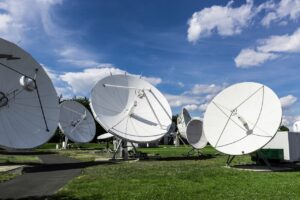 noticed an old radar dish on top of the building. After a while, I saw people installing or repairing a big pair of spider web-like antennas atop a room on the roof, which piqued my interest. At that time, I was a member of the Electronics Hobbyist Club. Our moderator turned out to be a member of the Amateur Radio Club and gave us a tour of the ham shack, better known as The Tower. That was the “Eureka” moment for me. The sound of static, distorted voices, and the excitement of the operators were permanently imprinted in my mind. I never bothered to renew my membership with the Electronics Hobbyist Club the year after.
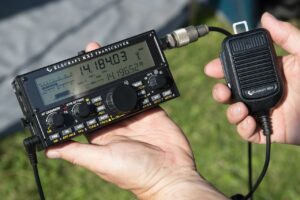 When I finally joined DBTC Amateur Radio Club, DU1DBT (later DX1DBT), in 1985, I knew it is different from the rest. I quickly got the concept of it all. It is basically making new friends, introducing yourself, giving your location, what kind of radio and antenna you are using, what the weather is, etc. No politics or religious discussions, only neutral topics. Here is a place where everyone is equal and live in harmony, whatever your race or creed. Amateur Radio is also an excellent method of applying the engineering/electronics theory we learned at school.
I finally had the chance to go DXing after about a month. I remember practicing every day, simulating a DX QSO aloud even while walking home. I made sure no one heard me of course! Lest they think I was a lunatic! When the big day came, I was ready. However, I will not deny I was very nervous since no one was there to hold my hand. Eventually, our batch dwindled to five; Jojo, Francis, (?) Reyes, Ernie(RIP), then promoted as regular members. I was exposed to the HF contesting almost immediately and fell in love with it. Forty-eight hours of building antennas, using the radios, and staying at the Tower on a weekend! What more can you ask? It was the ultimate sleepover!
I became Junior Vice President soon after. I learned that leading a small but highly skilled group is very challenging. There was definitely pressure from the senior officers to perform well and maintain a high-level grassroots program to propagate the hobby. Being a student, I didn’t have the budget for a proper ham radio of my own. I also did not feel the urgency to get a license. I was content with using the club’s callsign and equipment. When I had the opportunity to acquire my own radio, I grabbed it! Don’t laugh because what I got then was an old CB radio. It felt like driving a Ferrari all your life and then suddenly opting to ride a rickety bicycle! However, the cost was less than a fifth of a portable VHF radio back then and this gave me the opportunity to practice my RF knowledge outside the club. I also met a couple of new ham friends, DU1FDQ (Alfon, now DU1RF) and 4F1EKP (Leo). With their help, the 11-meter band became my training ground for CW. Soon after in 1990-91, I took and passed my Class C and B exams. I became DU1JIG, bought an Icom IC-02N, and homebrewed a… you guessed it… a two-element cubical quad. I became eligible as a Board Member and was the club Vice President from 1992 to 1993, then President from 1993 to 1994. This also gave me the confidence to try operating CW as well as RTTY and AMTOR modes. It was also the time when most of the members were licensed hams (DU1GCV, DU1MHX, DU1JGT, DU1JXP, DU1IWT, DY1IQR, DY1IPL, forgive me for the ones I missed).
I left the club in 1994 when I graduated from college. Well, I never left because how do you really leave home? Your original home will always be part of you. I still attended club activities, especially contests, whenever I can. The last was a club promotion in 2002, shortly before I migrated to Canada. Eventually, the hobby was put on the back burner so I can concentrate on starting a new life and getting settled. I met a fellow ham, Brian, VE3BWP, in 2003. He is my first Canadian Elmer.
A turning point happened in mid-2011 when I acquired a Kenwood TS-520, the North American equivalent model of the club’s TS-520D. I had no choice. There was no more excuse to delay writing my amateur radio exam. My Basic (With Honors) License was issued on September 1, 2011. As luck, or should I say destiny, would have it, I got VA3DBT as my callsign. With the help of Brian, VE3BWP, and Rene, VA3RLU, I was able to go on air in no time. My tiny twenty by thirty feet backyard was able to accommodate Delta Loops for 10, 15, and 20 meters. Loop antennas are automatic choices for me. The month after, I had no hesitation in joining the 2011 CQ WW SSB Contest getting 100,000+ points, as well as other major contests after that such as the CQ WPX SSB and ARRL Inter DX SSB Contests.
During one of these contests, I experienced a pleasant surprise during a pileup. As the station I was trying to call heard my suffix, he excitedly asked, “Are you Delta X-ray One Delta Bravo Tango?” I said negative and gave my complete callsign. I wanted to tell him I came from DX1DBT and it is the origin of my callsign but decided against it because of the pileup. It gave me deep satisfaction knowing my beloved club is still recognized during contests.
I also met Ben Gamboa, VA3BEN, ex-DU1BG in late 2011 and immediately felt a strong affinity to him. Later, I discovered that he is one of the founders of the Philippine Amateur Radio League Inc. and a good friend of the founders of DU1/DX1DBT! He migrated to Canada in the 1960s. What are the odds of meeting such an important person in Philippine ham radio history on the other side of the world?
With the help of my Canadian Elmers and fellow hams, VA3BWP (Brian), VA3BEN (Ben), VA3NOY (Nonoy), VE3RQS (Rod), VE3UQH (Felix), VA3RLU (Rene), VE3LHY (Jos), VA7HTZ/VA7XDB, ex-DU1IWT (Howard), VA3JZR (Miguel), and hopefully more, I am looking forward to propagating the legacy of DU1/DX1DBT here and beyond.
73!
de VA3DBT, ex-DU1JIG
Mel Monit